Berkeley Republican students yesterday sold cupcakes priced according to the buyers' ethnic identity and gender. "White cupcakes" very expensive; "others" very inexpensive.
It was meant to highlight what the Republican students see as inequalities in proposed admissions legislation that would allow the UC's to take a person's ethnicity and gender into account for purposes of admission--an important public issue that deserves intelligent debate.
Therefore, I'd like to know how much the students involved are paying for their education.
For men and women benefiting from one of the highest quality educations in the nation, and the world, the analogy they made was remarkably unsophisticated, brute, and empty of real content.
I don't think their parents are getting their money's worth.
Wednesday, September 28, 2011


Friday, September 9, 2011
Long Term Considerations in Ceramic: COE
I've seen more and more people putting crushed soda lime and other glass on ceramic. I've been hesitant to do so. My reasons follow.
Ceramic glazes are also "glass on ceramic." They are carefully calculated, so that they expand and contract at the same rate as the ceramic on which they are used. This is to make sure that they adhere to the clay surface over the life of the object, and don't come off. Glass can expand and contract with changes in the weather & the immediate environment (such as a warm body, pool, shower, jacuzzi, winter).
The COE (coefficient of expansion) of soda lime glass (bottle glass) is 9. The average COE of common commercial high fire clays is in the neighborhood of 7. Porcelain drops down around 4. Both bottle glass and ceramic will expand and contract over their lifetimes--but at very different rates when the COE's are disparate.
A somewhat poorly matched glaze will craze--the "crackle" effect. However, increases in mismatching between glaze and ceramic can actually result in the glaze coming off of the ceramic. This may not happen immediately; it can occur up to several years after firing, when the two materials have gone through numerous cycles of mismatched expansion and contraction. This knowledge makes me reluctant to risk using commercial glass as a glaze on ceramic pieces.
Ceramic glazes are also "glass on ceramic." They are carefully calculated, so that they expand and contract at the same rate as the ceramic on which they are used. This is to make sure that they adhere to the clay surface over the life of the object, and don't come off. Glass can expand and contract with changes in the weather & the immediate environment (such as a warm body, pool, shower, jacuzzi, winter).
The COE (coefficient of expansion) of soda lime glass (bottle glass) is 9. The average COE of common commercial high fire clays is in the neighborhood of 7. Porcelain drops down around 4. Both bottle glass and ceramic will expand and contract over their lifetimes--but at very different rates when the COE's are disparate.
A somewhat poorly matched glaze will craze--the "crackle" effect. However, increases in mismatching between glaze and ceramic can actually result in the glaze coming off of the ceramic. This may not happen immediately; it can occur up to several years after firing, when the two materials have gone through numerous cycles of mismatched expansion and contraction. This knowledge makes me reluctant to risk using commercial glass as a glaze on ceramic pieces.
Saturday, July 9, 2011
Dirty Mouth?
That famous tag line from Orbit Gum commercials.
Now, there's Orbit Mist, a hydrating gum.
Do they market it in Germany? Would they leave out an entire market?
Why am I asking?
Mist means manure (really, the four-letter manure).
Dirty mouth?
Saturday, July 2, 2011
Square Red & Black Porcelain Button

Square Red & Black Porcelain Button
Originally uploaded by la_v_i_k_a
Square buttons...a rarity, and often a collector's item. That's something new, that I just learned, lately. I thought it was interesting and then thought you might be interested in learning something new about bright red glazes.
In the past, red was a dangerous color: cadmium is poisonous. Its glazes could also be finicky and disappointing, burning out at the slightest overheating or affected by copper glazes fuming nearby during the firing, both resulting in a bland unattractive gray. Your work was ruined.
Now, cadmium is encapsulated in zircon (a silicate & a word we get from the Middle East) before being added to glazes. Structurally trapped within zircon and used as a stain, in suspension, rather than as a soluble oxide, it cannot leach (and soak into your dinner salad, in other words!). The result is that you can eat off of bright red dishes, as never before.*
This button combines a metal saturate glaze, on the left (most likely some combination of copper & iron, along with cobalt--It shows a bit blue when thinly applied), with a bright cadmium red. An impossible combination, just a short time ago.
*Just be careful: if you bought that bright red decorated dish abroad, in an unregulated market, it may still be unsafe.
Saturday, June 25, 2011
Button Swap? It's a Snap!
 I'm always on the lookout for clothing items that have large buttons, so that I can take them right off!
This short-sleeved knit vest originally had a plain, large plastic button for closure, at the neckline.
I removed that button and replaced it with the female half of a large snap. (I now know where to find the same size snaps in black, but fortunately for this posting, these are silver and easy to see against the black knit.)
 Having whip stitched the buttonhole closed, I sewed a male snap part to the middle of the backside of the closed buttonhole. At that point, the vest could be snapped together, but had a blank, buttonless front.
Next, I sewed another female snap onto the outside, over the sealed buttonhole.
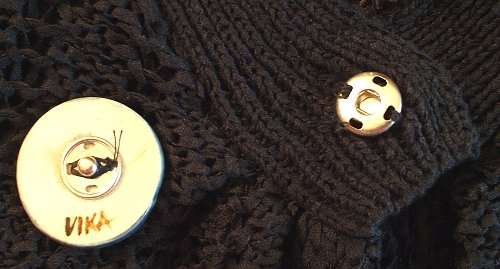 The last step was to sew a male snap part onto the back of my Dancer button and snap it onto my garment.
Now, by simply adding a male snap part to any of my buttons, I can change outfits at will!


Sunday, June 12, 2011
Bread Art & 2 Recipes
This blog never has been conventional & this won't help ;)
I got a bread machine at the second hand store earlier this year. Long years of no time for handmade bread (I get called away for taxi duties just about the time I should be kneading or right before the end of baking!) and I'd heard less than rave reviews regarding machine fare. However, knowing time had probably led to improvements and after reading some encouraging stories, I got one (second hand store, but first hand machine: never used!).
It took a little while to get used to. Liquids are the controlling substance for handmade loaves; you can always adjust flour. However, pan limitations make dry ingredients the limiting factor for machine-made loaves; it's the liquids that must be adjusted!
Enough talk. Here's two base recipes, one for rye and the other for wheat. They are easy to modify...add things you like!
Rye Bread
This recipe is for a 2lb loaf. I like to put the first three ingredients into a 4 cup measuring cup, because that's perfect.
1 C Dark Rye Flour
3 C Unbleached White Flour or Bread Flour
3 TBS Gluten Flour --this makes chewy Euro (German) style bread.
Add to bread maker pan:
2 strict tsp salt (or 10g)
1 TBS Demerara Sugar (I like it, less processed...it's only to feed the yeast)
2 TBS Oil
1-1/2 Cup Warm Water
-Dump 4 Cup mixture into bread maker pan, on top of liquids.
-Make a small well on top and add 1 TBS yeast (or 1 packet regular, NOT quick acting) (or 9g)
White Bread bake setting
2lb Loaf Whole Wheat Bread
In a 4 Cup Measure:
3 Cups Unbleached Flour
1 Cup Whole Wheat Flour (Put it in on top of white flour. Should go into pan first, & soak)
3 TBS Gluten Flour
Into Bread Pan:
3 TBS Oil
1-1/2 Cups + 3TBS Warm Water
2 tsps salt (complete tsps this time)
1 TBS Demerara Sugar
If you increase Whole Wheat, you'll need to increase water.
For both WW and Rye, you could go up to 1/3 ratio. 1.33 C/ 2.66 C White
1 TBS extra water if you increase Whole Wheat to 1.33 Cups
-Dump 4 Cup mixture into bread maker pan, on top of liquids.
-Make a small well on top and add 1 TBS yeast (or 1 packet regular, NOT quick acting) (or 9g)
Whole Wheat bake setting
Tuesday, May 10, 2011
Old Car in an Auction Lot, Fresno

Old Car in an Auction Lot, Fresno
Originally uploaded by la_v_i_k_a
My cousin's property around their home was "shaved" into a nice lawn, beyond which the remainder was left to grow. Just over the line, side by side, sat two old Chevy's-- full of dust, cobwebs and a variety of spiders. Despite my fear, I would climb into the cars. The enticement to go on long imaginary drives with my cousin Bonnie was way too hard to resist.
She drove. I kept an eye on the spiders.
Subscribe to:
Posts (Atom)