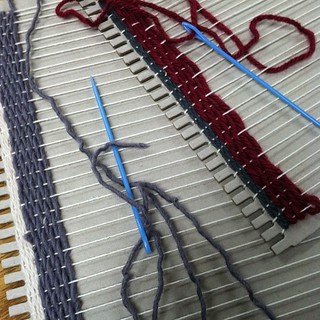
Tuesday, February 24, 2015

How to Warp a Chipboard Loom

There are many ways to use a 13" chipboard loom. What follows are two of the easiest warping methods.

Continuous warp. Weaving on one side, only.

Hold your yarn at the lower back side of the loom and wrap up and over the first notch, toward the front. Continue through the bottom notch that is directly opposite. Keep wrapping until you have reached the final bottom notch. Pass the yarn through this last notch and turn the loom over.


Tie the start and finish ends together, diagonally, across the back of the loom. You are now ready to weave, on the opposite side.

When you are done weaving, turn the loom over, so that notches are to your left and right. Using scissors, cut through the warp yarns, at their midpoint. Trim off the knot that is left from the diagonal tie.

Removing the Cloth

Remove the cloth from your loom and position a fringed side so that it is facing you. If you have used every notch, there should be an odd number of warp yarns. Treat the first two as if they were one: hold them together while picking up the third piece of yarn and tying a "shoelace knot." Gently snug the knot down to the weft. When this is done, tie a shoelace knot again, gently pulling until the knot is firm. Pick up the next two warp yarns and repeat, tying a shoelace knot that snugs the weft, and another to make a firm knot. Do this for all of the warp yarns on one side and then turn your work around and do it for all of the warp yarns on the other side.


If the fringe is too long for you, fold your work in half so that both fringes are on the same side. Slide the fringe over the edge of the table until the length you want ends at the bottom edge of the table. Making sure things are all even, hold your work down firmly and use the bottom edge of the table to guide your scissors in a straight line, as you cut the fringe.

Handwash according to the fiber you've used, to full it, or firm it up.

The work at right was done by my 3rd grade students, on 13x13" chipboard looms. They warped the looms themselves and all are first time weavers!


Individual warp. Weaving on both sides.


Each warp end tied into a bow
You will need to cut individual pieces of yarn for your warp. The pieces should all be of exactly the same length. The length for each piece is at least 31 inches. Twenty-four inches will cover the length of both sides of the board. The other seven inches will be used to tie a bow. If you have thicker warp yarn, or your fingers aren't happy tying small bows, you will need to cut lengths that are a bit longer. TEST your fiber, first! Then use that perfect length to correctly measure the others.

Take each length and bring it through a bottom notch on the board. Draw the ends up to the notch exactly opposite and tie a bow there. Make all your bows on the same side. Now, you can weave from the bows end, down the loom to the bottom. Add a few extra rows of weft when you reach the bottom notches--you'll need them to fill the slight gap that will result. Turn the loom over and continue weaving from the bottom, up to the bows, at the top. When you are done, untie the knots and unfold your cloth from the loom. Ease the extra rows of weft into balance.

From tying the fringes through fulling, the remaining instructions are the same as those for removing the cloth, above.

Warning:
Never warp a chipboard loom so that the warp is looped around the pegs, as you might with a wooden loom. The tension will break the pegs off.

If you ever do happen to break a peg, go to a coffee shop, have a coffee and save your wooden stirring stick. Bring it home and snap off an inch or so from both ends. Using wood glue, glue one on each side of the peg, with round ends out.

Chipboard Looms can be found at vika.etsy.com

Wednesday, December 10, 2014

The Torture Report is a Tool

Torture creates exemplars--for the purpose of quietly extorting obedience from the collegial cohort, and power--and silence--from officials. It is never for info-gathering. 

Torture is never about gathering information; it is about controlling a large system, a large group of people, by beating a few, with impunity. It is profoundly about controlling your own audience and keeping them in line.

It is about covert power.

In such a system, a confession is *not* about cleansing and renewal; it is about conserving covert power from exposure and destruction.

Confession occurs at the time the system is about to rupture, at the time it is threatened either internally or externally with rebellion, exposure and housecleaning.

The confession elicits empathy, averts further inspection and creates delay -- delay during which the system can regroup, consolidate...and avoid additional losses.

The CIA never wants to see another housecleaning like that imposed upon it by Ford, in 1974, after Watergate.

With the Torture Report, they have accomplished that goal.

Pragmatically, no matter the rhetoric, the reality is that the Torture Report confesses nothing. It didn't tell us anything we didn't already know. We knew waterboarding was torture. We knew justice had been subverted at the very top to make way for it. What the Torture Report doesn't tell us is how the CIA subverted the judiciary in order to make it legal and how it kept the President, and others, from challenging the miscarriage? Why did so many people capitulate? Why was everyone frozen?

See the opening sentences, above, and then read the article below.

"Vote all you want. The secret government won’t change."
http://www.bostonglobe.com/ideas/2014/10/18/vote-all-you-want-the-secret-government-won-change/jVSkXrENQlu8vNcBfMn9sL/story.html 

Saturday, November 22, 2014

Better to Militarize, Than Ask Permission

The history of North Ireland, Ulsterization, would suggest that the goal of providing military grade weaponry and training to local police forces is to obscure and decentralize a federal policy which, if carried out from the center, would incite widespread public backlash.

By allowing municipalities to choose to opt in (albeit using a time delimited offer of funding--a classic sales pressure tactic), the militarization of  local US police forces maintains a parochial appearance. As a result, opposition occurs primarily at the local level--any potential national protest has been effectively atomized. Conversely, while acceptance occurs in multiple locations, the offer continues to come from only one place, with a consistency and persistence that suggests that the militarization of local police is, in fact, a centrally generated agenda with the force of policy.

In its current expressions, this didn't go through Congress. If it continues, it will be de facto domestic policy. As an "un-policy," its managers are not subject to conventional federal oversight (note the military and surveillance equipment given to the police department of Oakland, California, within the same time frame that it has also been subject to a federal monitor, assigned following repeated gross misconduct by the department). Furthermore, direct lines of communication--and relationships of benefactor to beneficiary--have been created with municipalities around the nation, creating a direct federal relationship independent of federal and state government.

If we were to observe this development in another country, we would be asking about the potential for a future military coup, understanding surveillance and the loss of privacy as two of its primary antecedent features.

In contrast, here at home, in a narcissification of news and information, we persist in our delusions of exceptionalism and worry that someone read our emails.

Thursday, September 4, 2014

Terror Groups and Crime? Or, The Border Patrol and Crime?

Developing nations are ripe for transnational crime?

What about the convergence of TOC (Transnational Organized Crime, not Table of Contents) with US finance, corporations, oil, and state security departments?

The US Border Patrol is part of  US Homeland Security. The Border Patrol's infiltration is already documented. There are multiple documented instances of US finance being infiltrated. If finance is infiltrated, corporate infiltration must be assumed. This allows crime dollars to flow straight into American politics and elections. Who's buying our elections? Can we begin to seriously worry about a judiciary that favors corporations and those promoting opaque campaign monies? Can we count inexplicable judicial and executive decisions as early red flags of criminal infiltration, and extortion?

The threats that comprise extortion need not be explicit, or even conscious, among those familiar with the cost.

How are we talking about developing nations, when our own financial institutions and state security organizations have already closed deals?

A Look at Why Organized Crime and Terror Groups are Converging


See the rest of my reading list, here:
A Cartel Reader for Democracies


Wednesday, July 16, 2014

The Smoke Makes Aliyah


Smoke makes aliya
these days
The heart descends

Innocents sprinkled on a beach
scribing impunity in blood
and broken bones

On balconies
the congregants are stunned
As the smoke goes up
they rend our screens
in mourning

___________________________________________
"It's a shame they didn't identify them as kids with all
of the advanced technology
they claim they're using."
http://www.theguardian.com/world/2014/jul/16/witness-gaza-shelling-first-hand-account

Monday, May 26, 2014

Low Sugar Strawberry Jam

I learned how to make jam in my late teens, from a woman whose mother and father were Polish immigrants. The tedious job of processing the fruit --washing, removing pits, slicing, mashing--fell to me.

I also poured the paraffin she used in addition to bands and seals. Since, I've learned how to process the jam, just as safely, without the wax.

I love the taste of fruit in midwinter that canning affords, but I've always disliked the amount of sugar necessary to set the pectin.

Too sweet!


However, tons of sugar isn't necessary with the new pectins. Both instant pectin and low-sugar pectin make an excellent, tasty product. At least one company also offers a "scalable" pectin. You measure the right amount of pectin for the job: you can use a smaller amount of fruit and an every-day pot, instead of being chained to making a big batch in a stock pot or dutch oven. And, it's quick.

I usually make some variety of apricot jam, however, this year a gift changed things. A family at the local farmers' market produces ripe juicy strawberries you can smell from half a block away. I always buy from them, for the last several years, however, at the first market, they had sold out by the time I got there! All that was left was a basket of culls...which they offered me, for free, saying it would make delicious jam. It did. This week, I went back for 9 baskets and tried low-sugar jam, hot water bath processed.

6 Cups Mashed  Strawberries
4 Cups Sugar
Pectin


It started to set, right away-- no strawberry syrup, here.


Only four cups of sugar, compared to the usual 6-8...and the fruit flavor is just amazing. It tastes fresh. This is the jam you want to use for cakes and fancy sandwich cookies.


Monday, May 19, 2014

Handmade Peg Loom and Woven Cuff

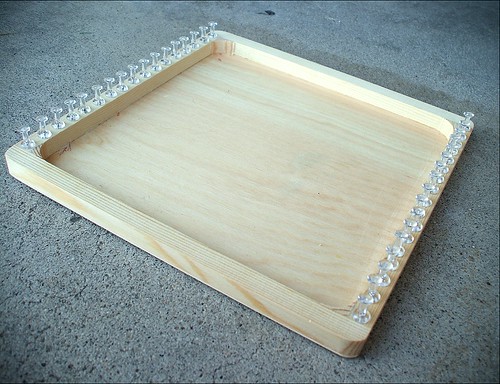
DIY Loom: wood frame with thumbtack pegs.
Spotted this lovely lightweight wood frame at the craft store. The depth suggested it might make a very nice base for a loom. I stopped by another shop and picked up plastic thumbtacks. The rest is history.


I left some room between the pins: I knew I wanted to do some warp experiments that included thicker material. (For a denser weave, not only could the thumbtacks be closer together, but it looks very possible to add another row of tacks--or map pins--on the outside edge, between those on top.)


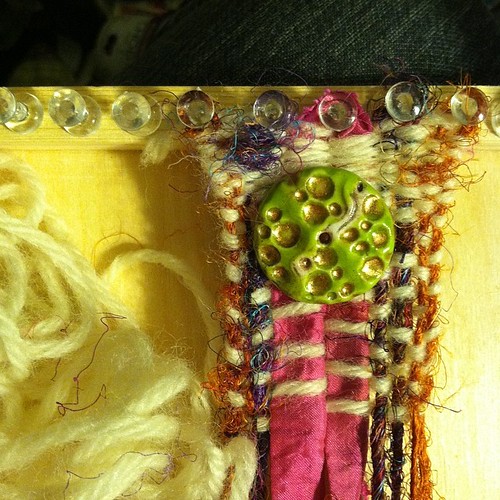
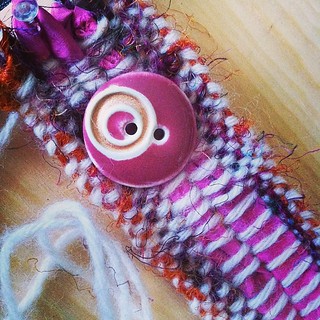
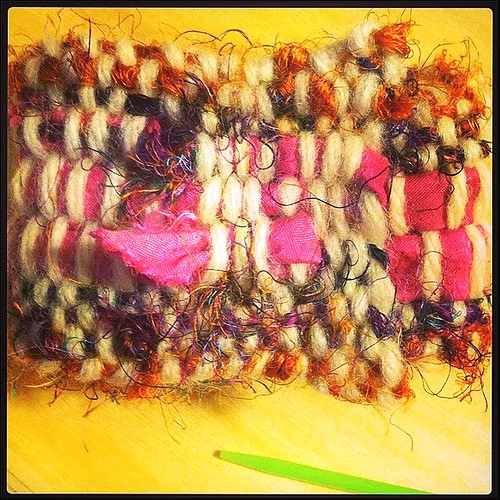
For this quick cuff, I used two lengths of golden yellow and purple, on each side. I wanted a tighter weave there and I wanted the design's edge to be defined. The center two lengths are coarse ribbon, without finished edges. They folded as I worked...I rolled with it.


 The differing yarns are joined using a knitter's "secret knot." The weft is natural wool. All of the warp is silk. I have plans for a larger scarf and I wanted to test the weight and drape of this combination. I was really pleased with the result.


I really enjoy adding the color and texture in the warp,
and using a plain weft. I think it will look especially
nice in a narrow/long scarf.