Sunday, December 3, 2017

How to Create Alternative Shanks for Art Buttons

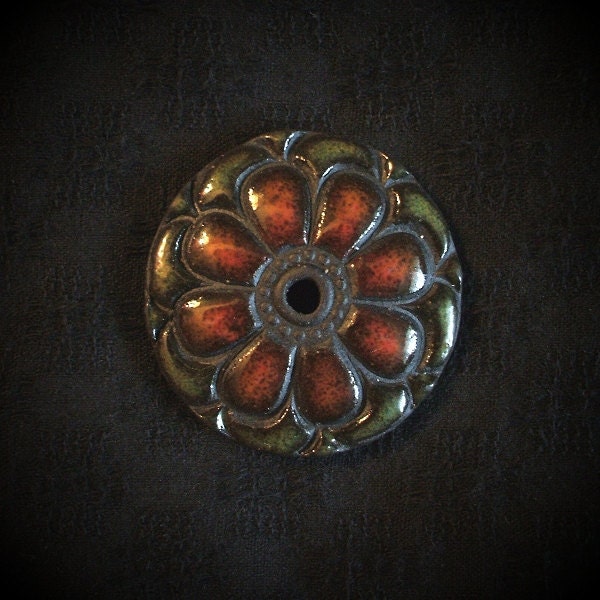
Dark olive green and black button with a center motif: the holes are "pinned" using black beads as anchors.
This button has a shank that utilizes
two black beads.
Your art button already has a design or texture and you don't want to obscure or change it by using standard sewing.

You've probably already noted "self shanks" -- where the hole is through a bump on the back of your button. You may also have come across pin shanks: just like it sounds, a metal pin with head is passed through a single hole, from the front to the back of the button, and bent into a loop.

There's more than one way to create a button shank. 


I've used a single, orange, linen thread so you can see what's going on. I'd recommend multi-strands, if you're sewing -- or a ribbon, if you are familiar with tying buttons onto fiber garments, so that they can be easily removed for washing. You may choose to leave the ends long enough to sew through your garment; you have options.


The thread is passed from the back of the button, through one hole. Then it's passed through the bead, and back through the button hole, to the back of the button. The first bead now forms an anchor pin.


The thread is now passed from back to front, through the second button hole. Then, through the second bead and back through the button hole. Both ends of the orange thread are now at the back of the button: even them out and snug them up. 


Pass each thread under the the loop that was formed in between the holes. You will tie them in a knot, at the middle. When you fold them across each other, to form the knot, you can also fold them over, and capture, any thread that forms the loop between the holes.
A little dot of superglue or fray check won't hurt, to secure the knot.


You might have worked with more than one thread. You have a choice, now. You can use the long ends to attach the button to your fabric, or you can snip them each to about 1/3 of an inch in length, and then, with your sewing thread, sew over the top of them as you attach the button to your garment, sewing through the center loop that you created. 


For more art buttons
vika.etsy.com

Wednesday, September 23, 2015

The Limits of Binary Religion

This country has a mental problem, literally. Math and art are not mutually exclusive entities inhabiting separate worlds, let alone separate hemispheres of the brain. Both are abstract, symbolic representations of realities that exceed the bounds of language. 

They mediate the too big, too small, and too profound for words.

Saturday, May 2, 2015

Letting Math Students Drive the Car

One of the most amazing experiences I had, once I started driving, was getting lost on routes that were very familiar to me. I quickly realized that sitting in a passenger seat and observing whether the route was correct, or not, was not the same skill as driving the car, myself, in the correct sequence.

When I began to have the opportunity to teach regularly, it occurred to me that the same was true of the difference in comprehension behind analyzing questions--and constructing them. I began to ask middle school students to construct test questions, in lieu of answering them, or to create the questions for a unit quiz. I often ask students to work in teams because they teach each other as they demonstrate their individual approaches to completing a task. It's always better to have more tools in the toolbox.

Currently, I'm providing remedial support and enrichment in an after school program funded by the state. During their regular daytime classes, my elementary students are working on learning how to do two part math problems, problems that require two different operational steps. This is what happened this last week.

I teamed students up in threes. We wrote down all the possible pairs of the four operations on the board and I asked them to choose a pair and work together to write their own two part math problem.

Each small group presented their problem to the class for solving, and I wrote the equations on the board, as the class articulated them. We got done, I thought it was enough, especially for the first time and the time of day. It was nearly 5pm! "Nooo!," they yelled out, "This is FUN!" "We want to do MORE!"

So, they wrote more and better. I said that one of the operations had to be multiplication, this time, and this time the team also took over writing the equation, as they presented to the class. They learned quite a bit when the equation would reveal an error in their writing, or a lack of clarity.* They were very creative, including their own names and interests in the problems. I shared with their daytime teachers and their faces lit up--let's try that!

I felt that constructing their own problems would help them to more easily distinguish the separate steps and the necessary vs. unnecessary information in the problems they must solve. It's the difference between sitting in the back seat, and finally driving the car.


*This is also a language arts assignment that naturally supports the development of detailed and accurate writing, something they are also currently working on.

Friday, April 24, 2015

My Etsy Calculator

I find it very helpful and thought you might, too. Feel free to download it from the Google docs link, below.

When you download the calculator, you'll find a gray box at the upper left. The numbers in the gray box are supplied by Etsy. You can change any of them, if Etsy increases their listing fees, sales commission, or card processing fees--the calculator will still work.


There are actually two calculators. The first lets you input what you are charging for an item and how much you are requiring for shipping. It will then calculate what your net will be, after fees and shipping are subtracted.

The second calculator allows you to enter the amount you would like to receive for an item and how much you plan to charge for shipping; it then calculates what you should charge in order to receive that net amount, after fees and shipping.

You can check the two calculators against each other.  Only the cells that should take inputs will allow your input. There are also a few notes, just click on the small red square at the upper right of any cell that has one, for additional information.

I hope it saves you as much time as it does me!

Etsy Calculator
You'll be provided with an image. Look to the top of your screen for download icon/link.

Monday, March 9, 2015

A Third Way to Warp Your Chipboard Loom

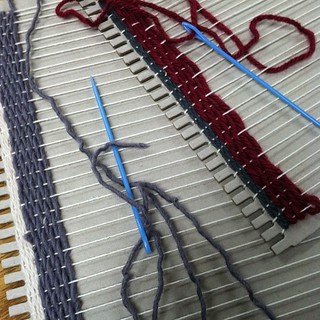
In How to Warp a Chipboard Loom, I shared two ways to warp your loom: continuously and individually. The first allows you to weave on one side and the second allows you to weave the entire board, front to back. (Pictures to come.)

Individual warping takes some time. If you want to warp quickly and still use both sides of the loom, there is still another way to warp. If you purchased a prewarped loom from me at Stitches West, in Santa Clara, then you may have a loom warped in this manner.

In this third way to warp the loom, the warp is wrapped continuously around the loom. Normally, this leaves the reverse lacking one warp end. I've modified the looms, by drilling two neat holes at opposite ends. This allows the opposite ends of the warp to be anchored at the back of the loom and creates the missing warp end. It also creates an additional warp end. Whenever you weave, starting on the front, the tail of the additional end will be closest to your work when you turn the board over. Pair that extra with the line of warp next to it and weave over/under them as one. Treat the other end as what it is, a continuation of the end that began on the front of the board, passing over and under it on return, as you weave the back side.


Because this style of warping leaves no extra, you will need to begin weaving at least an inch from the notches, and finish weaving at least an inch from the notches, on the reverse. When you snip the warp, close to the notches, this will leave you just enough to finish the ends of your cloth. If you need longer ends, just begin and end farther from the notches.

When you are done, loosen the two anchored ends of yarn from the board, so that they hang free, and snip your work free from the loom, as close to the notches as possible. You can then trim the two longer ends to the same length as the others.

Chipboard Looms can be found at vika.etsy.com 

Tuesday, February 24, 2015

How to Warp a Chipboard Loom

There are many ways to use a 13" chipboard loom. What follows are two of the easiest warping methods.

Continuous warp. Weaving on one side, only.

Hold your yarn at the lower back side of the loom and wrap up and over the first notch, toward the front. Continue through the bottom notch that is directly opposite. Keep wrapping until you have reached the final bottom notch. Pass the yarn through this last notch and turn the loom over.


Tie the start and finish ends together, diagonally, across the back of the loom. You are now ready to weave, on the opposite side.

When you are done weaving, turn the loom over, so that notches are to your left and right. Using scissors, cut through the warp yarns, at their midpoint. Trim off the knot that is left from the diagonal tie.

Removing the Cloth

Remove the cloth from your loom and position a fringed side so that it is facing you. If you have used every notch, there should be an odd number of warp yarns. Treat the first two as if they were one: hold them together while picking up the third piece of yarn and tying a "shoelace knot." Gently snug the knot down to the weft. When this is done, tie a shoelace knot again, gently pulling until the knot is firm. Pick up the next two warp yarns and repeat, tying a shoelace knot that snugs the weft, and another to make a firm knot. Do this for all of the warp yarns on one side and then turn your work around and do it for all of the warp yarns on the other side.


If the fringe is too long for you, fold your work in half so that both fringes are on the same side. Slide the fringe over the edge of the table until the length you want ends at the bottom edge of the table. Making sure things are all even, hold your work down firmly and use the bottom edge of the table to guide your scissors in a straight line, as you cut the fringe.

Handwash according to the fiber you've used, to full it, or firm it up.

The work at right was done by my 3rd grade students, on 13x13" chipboard looms. They warped the looms themselves and all are first time weavers!


Individual warp. Weaving on both sides.


Each warp end tied into a bow
You will need to cut individual pieces of yarn for your warp. The pieces should all be of exactly the same length. The length for each piece is at least 31 inches. Twenty-four inches will cover the length of both sides of the board. The other seven inches will be used to tie a bow. If you have thicker warp yarn, or your fingers aren't happy tying small bows, you will need to cut lengths that are a bit longer. TEST your fiber, first! Then use that perfect length to correctly measure the others.

Take each length and bring it through a bottom notch on the board. Draw the ends up to the notch exactly opposite and tie a bow there. Make all your bows on the same side. Now, you can weave from the bows end, down the loom to the bottom. Add a few extra rows of weft when you reach the bottom notches--you'll need them to fill the slight gap that will result. Turn the loom over and continue weaving from the bottom, up to the bows, at the top. When you are done, untie the knots and unfold your cloth from the loom. Ease the extra rows of weft into balance.

From tying the fringes through fulling, the remaining instructions are the same as those for removing the cloth, above.

Warning:
Never warp a chipboard loom so that the warp is looped around the pegs, as you might with a wooden loom. The tension will break the pegs off.

If you ever do happen to break a peg, go to a coffee shop, have a coffee and save your wooden stirring stick. Bring it home and snap off an inch or so from both ends. Using wood glue, glue one on each side of the peg, with round ends out.

Chipboard Looms can be found at vika.etsy.com

Wednesday, December 10, 2014

The Torture Report is a Tool

Torture creates exemplars--for the purpose of quietly extorting obedience from the collegial cohort, and power--and silence--from officials. It is never for info-gathering. 

Torture is never about gathering information; it is about controlling a large system, a large group of people, by beating a few, with impunity. It is profoundly about controlling your own audience and keeping them in line.

It is about covert power.

In such a system, a confession is *not* about cleansing and renewal; it is about conserving covert power from exposure and destruction.

Confession occurs at the time the system is about to rupture, at the time it is threatened either internally or externally with rebellion, exposure and housecleaning.

The confession elicits empathy, averts further inspection and creates delay -- delay during which the system can regroup, consolidate...and avoid additional losses.

The CIA never wants to see another housecleaning like that imposed upon it by Ford, in 1974, after Watergate.

With the Torture Report, they have accomplished that goal.

Pragmatically, no matter the rhetoric, the reality is that the Torture Report confesses nothing. It didn't tell us anything we didn't already know. We knew waterboarding was torture. We knew justice had been subverted at the very top to make way for it. What the Torture Report doesn't tell us is how the CIA subverted the judiciary in order to make it legal and how it kept the President, and others, from challenging the miscarriage? Why did so many people capitulate? Why was everyone frozen?

See the opening sentences, above, and then read the article below.

"Vote all you want. The secret government won’t change."
http://www.bostonglobe.com/ideas/2014/10/18/vote-all-you-want-the-secret-government-won-change/jVSkXrENQlu8vNcBfMn9sL/story.html 

Saturday, November 22, 2014

Better to Militarize, Than Ask Permission

The history of North Ireland, Ulsterization, would suggest that the goal of providing military grade weaponry and training to local police forces is to obscure and decentralize a federal policy which, if carried out from the center, would incite widespread public backlash.

By allowing municipalities to choose to opt in (albeit using a time delimited offer of funding--a classic sales pressure tactic), the militarization of  local US police forces maintains a parochial appearance. As a result, opposition occurs primarily at the local level--any potential national protest has been effectively atomized. Conversely, while acceptance occurs in multiple locations, the offer continues to come from only one place, with a consistency and persistence that suggests that the militarization of local police is, in fact, a centrally generated agenda with the force of policy.

In its current expressions, this didn't go through Congress. If it continues, it will be de facto domestic policy. As an "un-policy," its managers are not subject to conventional federal oversight (note the military and surveillance equipment given to the police department of Oakland, California, within the same time frame that it has also been subject to a federal monitor, assigned following repeated gross misconduct by the department). Furthermore, direct lines of communication--and relationships of benefactor to beneficiary--have been created with municipalities around the nation, creating a direct federal relationship independent of federal and state government.

If we were to observe this development in another country, we would be asking about the potential for a future military coup, understanding surveillance and the loss of privacy as two of its primary antecedent features.

In contrast, here at home, in a narcissification of news and information, we persist in our delusions of exceptionalism and worry that someone read our emails.

Thursday, September 4, 2014

Terror Groups and Crime? Or, The Border Patrol and Crime?

Developing nations are ripe for transnational crime?

What about the convergence of TOC (Transnational Organized Crime, not Table of Contents) with US finance, corporations, oil, and state security departments?

The US Border Patrol is part of  US Homeland Security. The Border Patrol's infiltration is already documented. There are multiple documented instances of US finance being infiltrated. If finance is infiltrated, corporate infiltration must be assumed. This allows crime dollars to flow straight into American politics and elections. Who's buying our elections? Can we begin to seriously worry about a judiciary that favors corporations and those promoting opaque campaign monies? Can we count inexplicable judicial and executive decisions as early red flags of criminal infiltration, and extortion?

The threats that comprise extortion need not be explicit, or even conscious, among those familiar with the cost.

How are we talking about developing nations, when our own financial institutions and state security organizations have already closed deals?

A Look at Why Organized Crime and Terror Groups are Converging


See the rest of my reading list, here:
A Cartel Reader for Democracies


Wednesday, July 16, 2014

The Smoke Makes Aliyah


Smoke makes aliya
these days
The heart descends

Innocents sprinkled on a beach
scribing impunity in blood
and broken bones

On balconies
the congregants are stunned
As the smoke goes up
they rend our screens
in mourning

___________________________________________
"It's a shame they didn't identify them as kids with all
of the advanced technology
they claim they're using."
http://www.theguardian.com/world/2014/jul/16/witness-gaza-shelling-first-hand-account

Monday, May 26, 2014

Low Sugar Strawberry Jam

I learned how to make jam in my late teens, from a woman whose mother and father were Polish immigrants. The tedious job of processing the fruit --washing, removing pits, slicing, mashing--fell to me.

I also poured the paraffin she used in addition to bands and seals. Since, I've learned how to process the jam, just as safely, without the wax.

I love the taste of fruit in midwinter that canning affords, but I've always disliked the amount of sugar necessary to set the pectin.

Too sweet!


However, tons of sugar isn't necessary with the new pectins. Both instant pectin and low-sugar pectin make an excellent, tasty product. At least one company also offers a "scalable" pectin. You measure the right amount of pectin for the job: you can use a smaller amount of fruit and an every-day pot, instead of being chained to making a big batch in a stock pot or dutch oven. And, it's quick.

I usually make some variety of apricot jam, however, this year a gift changed things. A family at the local farmers' market produces ripe juicy strawberries you can smell from half a block away. I always buy from them, for the last several years, however, at the first market, they had sold out by the time I got there! All that was left was a basket of culls...which they offered me, for free, saying it would make delicious jam. It did. This week, I went back for 9 baskets and tried low-sugar jam, hot water bath processed.

6 Cups Mashed  Strawberries
4 Cups Sugar
Pectin


It started to set, right away-- no strawberry syrup, here.


Only four cups of sugar, compared to the usual 6-8...and the fruit flavor is just amazing. It tastes fresh. This is the jam you want to use for cakes and fancy sandwich cookies.


Monday, May 19, 2014

Handmade Peg Loom and Woven Cuff

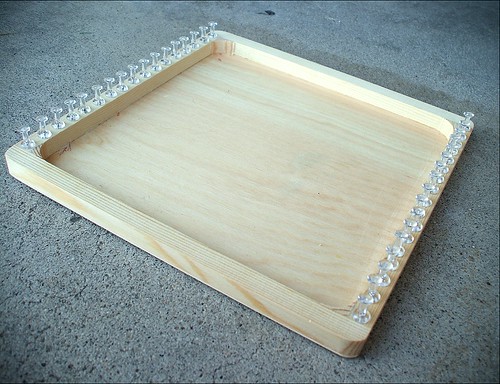
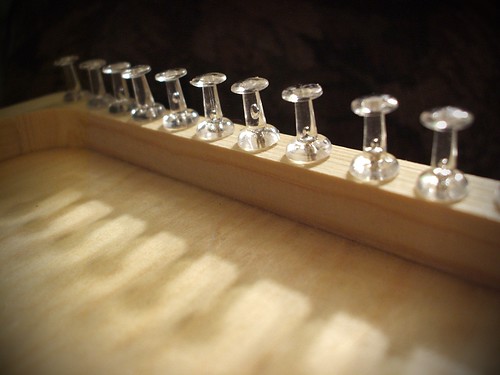
DIY Loom: wood frame with thumbtack pegs.
Spotted this lovely lightweight wood frame at the craft store. The depth suggested it might make a very nice base for a loom. I stopped by another shop and picked up plastic thumbtacks. The rest is history.


I left some room between the pins: I knew I wanted to do some warp experiments that included thicker material. (For a denser weave, not only could the thumbtacks be closer together, but it looks very possible to add another row of tacks--or map pins--on the outside edge, between those on top.)


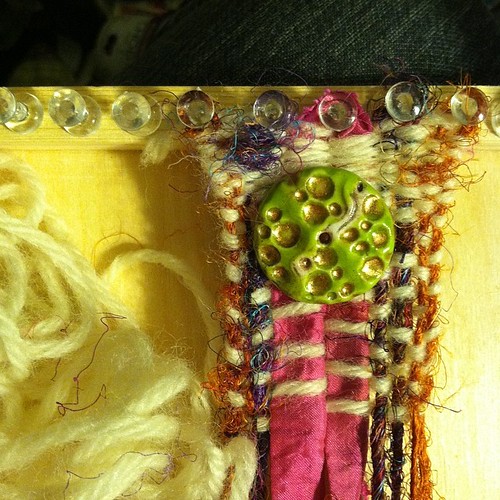
For this quick cuff, I used two lengths of golden yellow and purple, on each side. I wanted a tighter weave there and I wanted the design's edge to be defined. The center two lengths are coarse ribbon, without finished edges. They folded as I worked...I rolled with it.


 The differing yarns are joined using a knitter's "secret knot." The weft is natural wool. All of the warp is silk. I have plans for a larger scarf and I wanted to test the weight and drape of this combination. I was really pleased with the result.


I really enjoy adding the color and texture in the warp,
and using a plain weft. I think it will look especially
nice in a narrow/long scarf. 


Sunday, April 20, 2014

Wool Soap Sock

Large oblong bars of soap are my nemesis. They won't stay put in the shower. They pop out of my grasp and go flying. The deeper dish that finally captures them also turns them to mush, as they sit in the puddle, at the bottom. I like the felted soaps, but what I really wanted was an updated version of my loofa.

What if...


The business end. Note that I've left 2 pegs out of the job.
I've left two pegs out of the job.
I bought this little pocket loom, on a whim, a couple of months ago. It looked handy and easy to pack along. I also have some pure wool yarn I've been eager to play with. Well, actually, I had already played with it and created a mini-monstrosity that needed to be ripped out. Sometimes, stuff doesn't work.


So I ripped it out and doubled the yarn. By doubling the yarn and not using all of the pegs on the loom, I hoped to created a very tight tube for my soap. Why so tight and doubled? I hope that as the soap shrinks with use, there will be enough tension and enough fiber to allow the tube to remain fitted, and not sag around the soap.

The full picture.
I drawstring finished this end.


Binding off.
Waxy colored pencils
don't leave any marks.
This soap is bulky.
After drawing it closed,
I also added a finger-
crocheted loop.


Soap bar in knitted sock.
My handspan (length) is about 7"

So far, so good. It's snug, it felts with use, I can hang it up so it dries out thoroughly, and it's just the right amount of rough. We'll see if my "shrink-to-fit" plan works out...

Wednesday, April 16, 2014

From Nail Buffer to Sanding Tool

Working in mixed media, I enjoy borrowing tools from other arts and trades, and using them in unconventional ways. Even more, I enjoy modifying and creating my own tools.

I was in a dollar store one day, when I realized a beautician's nail-buffing tools might also be excellent for finishing metals. They were! However, the sanding papers didn't hold up under water and the grits, intended for acrylic nails, were quickly depleted.

So, I combined the beauty shop and the auto shop to make a new tool.


Taking wet-dry sandpapers in very fine,1500, 600 and increasingly coarser fine grits, I cut strips of each in exactly the same size as those on my buffing bars.


Fine, wet-dry sanding papers can be found at OSH hardware stores, near the paint section. If you don't find them in your hardware store with the sandpapers, near the paint, or with wood finishing products, try an auto shop--they should be able to tell you where to acquire the product, locally.

.

Carefully peeling off the old strips, I discovered there was still quite a bit of adhesive left; they were ready to go (a thin layer of E6000 glue would have been my go-to, had that not been the case).If you find the padding has degraded, try craft foam with the adhesive backing, as a substitute.


I applied my wet-dry strips in order of fineness and now have an inexpensive, easily replenished sanding tool perfect for small work, that can be used with water--as a lubricant and to reduce fine dust.

As a bonus, I also discovered the end caps were removable and the interior is large enough to hold the fish-hook sharpener I use for making pins.

Sunday, September 22, 2013

A Cartel Reader for Democracies

A democracy's control of its monetary system is fundamental to its autonomy and freedom. Opacity of banking and corporate transactions, as well as opacity of organized crime communications, is a threat to democracy. The compromise of a state's security organs by organized crime is frightening. The compromise of a nation's military veterans and (potentially) contractors should make a democratic people tremble.

It appears that the subversion and de facto acquisition of our banks, security organs and military might be well underway.

The cartels should be reckoned into any discussion of Manning, Snowden and the NSA. 

One may appeal to the Constitution over the NSA; to whom may we appeal when cartels have acquired Snowden's documents and advanced capabilities in infosec and surveillance?

Sampling from my personal reader/collected links on relevant topics.
Updated 12/15/2014
--------------------------------------------------------------------------


Obama Declares War on Global Organized Crime 2011
US Imposes Sanctions on Four International Criminal Groups
Executive Order
Japan: US Declares War on the Yakuza


McCain Petitions to Add Russian Group, with Kremlin Contacts, to List
Senator McCain Calls Upon President Obama to Apply Aggressive New Sanctions Designed to Combat Terrorism to the Russian Organized Crime Group Who Murdered Sergei Magnitsky


The Opacity of Takeovers and The Danger of Whistleblowing


Infiltrated Corporations
Olympus: A Rotten Picture at Olympus
State Oil Company Infiltrated in Mexico: Los Zetas called Mexico's most dangerous drug cartel.
(I'll welcome additional links. Explains NSA interest in Brazilian oil auctions? Very attractive to organized crime.)
Brazil: Brazil Police Op Uncovers Organized Crime-Politics Link


Infiltrated Banks
Wachovia: How a big US bank laundered billions from Mexico's murderous drug gangs
Wachovia and Others:    Wachovia's Drug Habit
Colombia: Western banks 'reaping billions from Colombian cocaine trade'
US and European Banks Hunger for Liquidity: American Narcos: The Real ‘Masters of Paradise’
If it waddles like a duck...
The Scam Wall Street Learned From the Mafia
*An attempt at Weaning? -- Secret Fed Loans Gave Banks $13 Billion Undisclosed to Congress
Global: Drug money saved banks in global crisis, claims UN advisor
Germany: The Case Gustl Mollath – The Time of the Hyenas A critical media research by Ursula Prem
(The researcher for the article above implicates journalists in the crime. Free press, or infiltrated, too?)
Germany: Court Releases Whistleblower from Psychiatric Ward
Russia: Shadow of Magnitsky Case Reaches Switzerland

Switzerland: Switzerland Awash with Money Laundering Cases
 

Anonymous Discovers Cartel's IT Quotient, Unbound by Any Constitution (Cartel Promises to Acquire Increased IT Capacities)

Cartels aren't as limited as governments; they promise to find what governments can't.
(Note that they are ruthless about secrecy. Makes NSA a worthy target, Snowden a desirable acquisition?)
Anonymous Retreats from Mexican Drug Cartel Confrontation
Dispatch: Anonymous' Online Tactics Against Mexican Cartels

Cartels Making Good on Comms Capacities

More on Los Zetas Radio Network

"the kingpins stay off the network — they use the internet to send messages"
Radio Tecnico: How The Zetas Cartel Took Over Mexico With Walkie-Talkies (added 12/15/2014)


Facebook Hitman Highlights Organized Crime's Online Presence

Latin America and Caribbean Cyber-Security Trends and Government Responses (Trend Micro) (PDF)

Raises serious questions re: Ecuadorean interest in hosting Assange, Snowden
Mexican cartels move into Ecuador

Brazil Investigating Hack of Military Police Data

Cartels are keeping up, but "law enforcement and governments were failing to keep up with advancing technology."

Complexity: Persian Gulf is Growing Drug Hub for LatAm Groups


State Security Subverted


ATF
Evidence Suggests Cover-Up in ATF Scandal, as More Guns Appear at Crime Scenes

Border Patrol

Mexican hitman claims cartels bought guns from US Border Patrol
(06/12/2014) Removal of border agency’s internal affairs chief raises alarms
"members of drug cartels and gangs have been applying for jobs in the U.S. government “for the purpose of corrupting the system by passing along intelligence, sharing intelligence gaps, showing vulnerabilities.”"
(08/19/2014)
Ousted chief accuses border agency of shooting cover-ups, corruption

Secret Service
Secret service agents sent home after Colombia prostitution allegations
Inspector General's Report Contradicts Secret Service on Prostitution Scandal

Secret Service Back Story
Secret Service Agents in Colombia are Eavesdropping on Suspected Counterfeiters

(I am looking for another link--I lost it--Secret Service wrapped up a joint counterfeiting bust in Colombia not long before Obama's visit. The prostitution scandal reads like a "shot across the bow," from that vantage point.) Reference: Europol 13 April 2012

Military Veterans

Cartels are Recruiting US Soldiers as Hitmen, and The Pay is Good
(01/10/2013) Team of contract killers led by ex-soldier 'Rambo' busted, prosecutors say (I predicted this several years ago; it was obvious--veterans returning to a non-existent job market and Zetas expanding. I hope my other prediction doesn't come true: cartels with enough liquidity to hire US military contractors, subvert their employees, or  hire teams of their unemployed workers. --Unfortunately, it's possible (probable?) that's already happened. (24/9/2013) See text, re: US contractor, blue box, on this page: NarcoPetro Dollars – Zetas Inside Pemex)

NSA?

--------------------------------------
If a post can be dedicated, I'd dedicate this one to the friends of Gustl Mollath, who stood by him for so many years, and to those still working for justice for Sergei Magnitsky.

Sunday, September 8, 2013

Mangling the Snowden Questions

How many current journalists have the capacity to analyze digital content for payload? Set up secure communications? Storage?

Greenwald doesn’t; he’s being “managed” by his source.
What does that do to journalistic integrity?


Why Greenwald?

He looked sympathetic? How did Snowden come to prioritize sympathy over info security?

To others, Greenwald might have looked ideal: sympathetic to an NSA whistleblower, unskilled in info security, and residing in South America.

Who’s interested in info security in South America?

The answer to that question makes Greenwald look like the ideal delivery system…

It’s the job of journalists to not believe in the “hero myth,” to be skeptics and to maintain their objectivity.

Did it become too difficult when the subject matter made them the story?


Personal privacy and freedom of the press are a no-brainer. From the beginning, the public conversation has been consumed with the completely obvious.

PRISM--we already know what it's bad for.

Is it impermissible to ask what it's good for?


Why?

Sunday, September 1, 2013

Could the Constitution be Employed in a Social Engineering Exploit?

Jay Rosen was kind enough to correct my understanding of Snowden's security precautions by providing a link to this recent article: How Laura Poitras Helped Snowden Spill His Secrets

So, it's inaccurate to characterize Greenwald as clueless. At the same time, material has still been transferred, via a journalist, to a realm where data security protocols are not the norm--where a password to the material is written down and carried on person, and where presumably few have the background to inspect the encrypted digital content of drives for more than document files, or to prevent skilled unauthorized access and transfers of material.

No one should misunderstand me to be saying press freedoms and protections, safety of person, or privacy, are of no consequence--they are of the utmost importance to democracy. But, much of the public conversation is one-dimensional, to the extent that it obscures consideration of  other threats to democracy that are equally potent and real, and that attend the transfer of digital information.

Peter Maass cites quotes Poitras' fears over the growing threat of the nation-based shadow governments. What frightens me is the absence of the cartels from the discussion--the shadow governments that have even less of their iceberg apparatus showing above water, rapidly expanding powers--extreme liquidity--and certainly access to just as much technological sophistication as any democracy.


They have repeatedly infiltrated global banking, subverted the Secret Service and possibly the ATF, hired returning American soldiers as hitmen and kidnapped digital communications engineers in a quest to create impenetrable communication systems. They could easily be the shadow governments with the most interest in crippling PRISM, acquiring information about NSA methods, accessing their files, and transporting an NSA level engineer into their realm. Is it coincidence, or of utmost concern, that cartel activity formerly based in Colombia has now moved to Ecuador? What about McCain's contention that there is ample evidence that Russia's most powerful organized crime group is deeply intertwined with their government, at the highest levels? When I note the two countries with the most interest in hosting Snowden,  I worry--for us and for him.


If the power most integral to the cartels' success is their ability to operate in secret, to create massive "icebergs" with very little showing above water, social engineering would be the most sensible method of acquiring the information they need. As a result, I don't just ask myself about freedom of the press and personal privacy, I also ask whether those values could not be socially engineered so that we, in our altruism, miss a sleight of hand. My questions bother me, but I don't think they're "bad" questions in the era of digital information: 

Could the Snowden affair go down as the social engineering feat of the decade? Was the Manning incident a practice run? Are journalism companies and individuals without info security protocols and training vulnerable, in the course of investigative reporting on traditional core Constitutional issues, to also being used as digital information vectors, in the service of organized crime?


We absolutely can't have a war on journalists' lives and our privacy, but we also can't afford not to know what these extremely wealthy, liquid and sophisticated sub rosa governments are doing, either. How do we protect our democracies from both threats?

I want to see that conversation.

Saturday, August 31, 2013

I Wrote the Password for International Security Documents on a Piece of Paper

The public discussion of  Snowden's leak has been as naive as Greenwald's handling of his digital files. It's criminal.

The paper media companies are so far behind the digital curve, still. Will they ever catch up? Putting digital files on a password protected hard drive or usb drive is not the equivalent of putting paper files into a safe with an alarm.

Do *any* of the major media companies have digital security protocols in place for their journalists? For their organization? If not, then they can't protect their sources and they're putting them at extreme risk. If you're reading this and you're considering becoming a source, I'd think twice about your choice of journalist and media company.

Judging from Greenwald's and the Guardian's data security behavior, they not only can't protect their sources, they also can't be certain that they haven't transmitted a digital payload, in addition to documents, to unintended recipients...anywhere in the world. 

The media doesn't seem to see this potential, but governments (such as the one that recently trashed some unsecured hard drives) and criminal groups surely do.

So, let's add some nuance and consider another angle. (If you think my imagination is too wild, just pretend it's a screenplay.) 

A hostile nation or crime group easily liberates top secret information from a secure facility by using an upper level mole to cultivate a whistleblower and provide him/her access to info and digital payloads. The discontented whistleblower walks out the door with more than just documents on a company laptop. The mole is untraceable. A counterintelligence tool enters public knowledge, internationally. Methods are revealed. Using algorithms and potent hashtags gleaned from past social media viral events, a team simultaneously and strategically posts the seeds that grow into an unnuanced public frenzy over privacy and hostility to government surveillance, of any kind. The whistleblower is subsequently offered protection by two countries professing concern about human rights, one of which has longstanding government connections to organized crime at the highest levels, the other host to one of the most powerful crime groups in the world. The digital files sit in the possession of a journalist with no clue about data security, and on the unsecured, crackable hard drives of a major media company. Having engineered the transfer of documents from a secure facility to multiple unsecured locations, the files are easily accessed by...

Monday, September 3, 2012

My Zinnia Button Becomes a Chanel Camellia

Ceramic Button: Zinnia in Stoneware
A few months ago, at my Etsy shop, I was contacted by a seamstress. She had purchased a unique item, my single-hole Zinnia button, in black basaltic stoneware. She shared with me that she planned to make a Chanel inspired brooch and add it to a wool suit ensemble. The wool fabric she'd chosen was being handwoven by another artist.

I was very intrigued.


After she'd received the button, I received a link to a picture of the button, along with the handwoven fabric. She also informed me that her plan was to enter the finished suit in this year's Make It With Wool competition. I had imagined the button as jewelry or as a button on a suit, but it had never occurred to me it might become something more.


The suit is now well under way and this last week, I received a link to the picture of the completed brooch. I think my mouth fell open; it is just gorgeous. I've included two pictures here so you can see it on the suit (at left) but also get a close up view of her work (at right).

For those of you working in metal and paper, you might want to click on the first photo and then see the link she provides to the tutorial used as inspiration and guidance--her plan was very well thought out.


Design, details, construction...this is just superb work. I am in awe.


Thursday, August 23, 2012

Permission to Engage?

In my early twenties, I stayed up late one evening with a coworker who was also a close friend, at his parents', after a day of fishing. We both worked at a residential program, primarily with heroin addicts, and it had been a long week. He was a vet and had previously told me of events during his two terms in Viet Nam--how he had lied and enlisted underage and then reenlisted after his first tour was over, because he was unable to deal with his return to civilian life. He shared how, in Viet Nam, he would sneak away and go to a local brothel, not for the girls, but because the woman in charge reminded him of his mother and treated him like a son. He still knew the words and phrases she had taught him and he had me learn them, too. He had no medals. He told me he had often won commendation, but would just as quickly turn around and do things that would earn him demotion. I was hardworking, and so was he, so I was puzzled that he would have regularly forfeited his "prizes." I had not yet connected prizes and "accomplishments" in a war zone.

Perhaps because it had been a very long day, or perhaps because all of the prior stories had set the stage, that night he began to share his experiences as a helicopter door gunner. I was young and I was naive and, before I knew it, his eyes were wide and his breathing quick and there was the feeling that we were in the door of the helicopter, side by side. The women gathered below, like his mother away from home, and their children, were numerous and close--he could see each one's face, looking up at him--as he did the job that was expected of him, drilled into him, as an American helicopter door gunner, in Viet Nam. He could barely articulate what he had just done and he was incoherent about what he was seeing, but the movement of his eyes, his posture and his imaginary weapon told the story, as did the shock and bewilderment in his eyes.

Later, he gave me his camos. I still have his jacket. Even years later, after we lost contact but happened to run into each other in another city on a couple of occasions, he refused to take it back, insisting I was the best person for it. I am just a little bit taller than petite, but it is too small for me, maybe a boy's size 16, not much larger. After a dozen moves and a million things lost, I still have it.

I hear my friend, again, as I listen to this soldier narrate this video we were never meant to see--he was there that day in Iraq, in the aftermath. We haven't learned much, because we don't admit where we've been or what we've done. We offshore the pain and suffering of our wars and try "not to look." It's not healthy. We owe it to them to sit alongside, and look.


  23 Aug 2012 10:56